Showing posts with label Bike Fitting. Show all posts

Sunday, 19 June 2016

Manchester BikeFit Review


I've long been a big supporter of the idea of getting your bike fit right.  Before you invest money in upgrades, it's best to invest in getting your position absolutely right on the bike.  A bit like sorting your swing before buying an expensive set of golf clubs.

Having got back into riding in a big way since 2008, it's become evident to me that the quickest ways to go faster on your bike as an amateur are generally: -

1. Losing some weight.
2. Upgrading your wheels.
3. Getting your bike fit right.
4. Employing a coach.  

Buying a carbon bike isn't the be all and end all of going fast as a amateur.  I'm able to put in average speeds within 0.5Mmph on my aluminum winter bike equipped with Mavic Ksyrium wheels.  

So, if you've done (1), spent on (2), then (3) +(4) should definitely be on your list of things to do if you've plateaued as a rider and don't seem to be able to shift your average speed.

Getting Fit and Fitted

The build up to deciding to go for a full on pro fit was driven by recurring tight hamstrings post ride.  Since employing a coach in August year, my volume and load had gone up considerably from 400 or so miles a month to 800+ including turbo interval sessions each evening.  We were both puzzled as to why the hamstring issue was occurring all of a sudden so a process of ruling things in/out ensued.  

First stop was a visit to Foot and Insole in Whalley (great place, review here) whereupon I'd had some custom insoles made to correct a supination issue (not standing straight basically).  Insoles are now worn in all my footwear aswell as cycling shoes and they've helped considerably.

Long story short, after several small tweaks to the on bike position without much luck, I ended up having an MRI scan which diagnosed a degenerating disc in my back.  The hamstring tightness being a related secondary issue due to the volume/load.  

The orthopedic consultant (himself a cyclist) suggested I source a place where all aspects of my on bike position, pedal stroke, cleat positioning, saddle etc could be reviewed to get things absolutely spot on and millimeter perfect.

Cyclefit Manchester

Whilst driving through the Northern Quarter of Manchester, I came across Cyclefit who had recently opened up a studio providing exactly what I needed.  They offer a range of services including a full professional fitting service with camera analysis, saddle pressure mapping, cleat set-up adjustment, physio assessment, the lot.  The main benefit being that you can be reviewed holistically, from feet upwards.  They already fit a number of professional cycling teams and professional riders from World Tour teams to Pro-Continental so they know their stuff.


Behind the Business

The business was started by Julian Wall and Phil Cavell.  You can read more about how and why it started here.  Bottom line was they were both injured, had investigated all sorts of medical interventions to get back on the straight and narrow, then had the epiphany that their on bike positions were critical to their recovery and - spotting a gap in the market in 1996, the rest is history.  

I got to meet both of the owners over a couple of visits and their passion for ensuring that your bike fit is as best as it can be came shining through.  Both highly knowledgeable guys, drilling down into all aspects of my own medical history within seconds of meeting them with eyes going up and down at the same time, sizing you up!

The Fit Itself

I went for the full professional fit with saddle pressure mapping (£225) and shoe/cleat positioning (£95).  Given the issue with my disc, I wanted to be 100% confident that - moving forward - I do everything possible to ensure comfort, performance and that my on bike position doesn't aggravate the situation

Arriving at the studio 

Greeted by fitter - Matt Hallam - we went into the studio where everything is set-up.  You're greeted by a bike rig, cameras, a big screen and all sorts of technical measuring equipment which is put into use during your session.  It's like a lab, full of tech and wizadry, just what you want.

Matt initially took me a through a detailed questionnaire about reasons for the fit, cycling objectives, health issues and general fitness plus flexibility. From there he did a physical assessment including measuring hamstring length, general flexibility, hip and leg length and all the other attributes which determine ultimately how you end up on the bike.  All these are being captured as you go straight into a report which gets e-mailed to you at the end.

Pelvic Measurement
Cyclefit also take all the measurements from your current bike and set up the rig exactly to the same dimensions so as to know the exact start point.  All this is recorded as they go on a record which gets e-mailed to you which explains where all the adjustments have been made and compares old. vs new.

The rig that it used for the fitting process is quite something, around £12K per unit to buy it seems.  The unique thing about it is that adjustments can be made in real time whilst you are riding.  There's no need to keep getting on and off or stop/start, so microscopic adjustments can be made on the fly.

Rig used for Fitting at Cyclefit
On The Rig

When you spin up the rig, all the cameras go on and video is captured of your rotation, front/rear movement, in fact pretty much everything.  Dots are placed on you at key points for the software to trackFrom that, several images are captured and the fitter can then determine the optimum angles.  


It's an iterative process.  The rig itself can be adjusted in real time with you on the bike, including saddle height, reach, so everything is done on the fly with your pedal stroke, hip movements, line of spine and overall position being monitored to ensure optimum position relative to your requirements and also the feedback that you gave in the consultation session.


Saddle Pressure Mapping

Cyclefit have a gadget (costs around £6K) which measures in real time where your pressure is loading on your saddle when cycling.  For me this was another key component - given my lower back situation - to get right.  The tool itself is a pressure mat which goes onto your saddle, with data capture software which then captures what's happening as you pedal to then convert into a heatmap (below).

As you can see , my current saddle and position meant I was totally front loading with hardly anything at the back which would have been aggravating the situation with my back/tendons.
Left Image = Current Saddle; Right Image = New Saddle + Position
Left Data= Current Saddle; Right Data= New Saddle + Position
After spinning up on the rig for five to ten minutes and having the saddle adjusted we got to a position where the conclusion was my current saddle (a Selle Italia gel flow) wasn't right for me.  Although I've always found it comfortable, the general design relative to my hips etc was leading to an imbalance in pressure and position.  

I've ridden Selle Italia Gel flow saddles for years, however analysis showed that a saddle change would be helpful and I changed to a Bontrager Montrose which got fitted in store whilst I was there (cost £89.99). The saddle was taking more of the pressure at the rear (desired outcome) which ultimately engaged the glute muscle group more.  

The chart below indicates where I was (left) to where we ended up (right).


Cleat Positioning

During the session, the fitter is also reviewing all elements of your pedal stroke.  When I visited Foot and Insole, we identified what they call a 'leg length discrepancy' which is very common it seems.  That is one leg is marginally shorter than the other.

As the session continued, various permutations of cleat position and packing were tried until an optimum was found.  All this you can see in real time on the TV screens via the cameras in front of you.  

For me it meant, the cleats were adjusted quite significantly with packing put between the footbed and the cleat to balance out power L/R aswell as an adjustment outwards on either side, pushing them away from the cranks.

I could never have got a cleat fit to this level of accuracy on my own. Having someone fully assess you on the rig, make the change, then see - via the data - what that does to your power and stroke is what you end up with.

Bringing It All Together


Walking away, quite a few changes had been made: -

  1. Saddle went up 13mm
  2. Cleat position was changed with feet pushed out around 10mm either side
  3. Saddle fore/aft was changed and put further back to line up my knees better during the pedal stroke.
  4. Packing was put underneath my shoes between the shoe bed and cleat.  Different levels were put under each side to compensate for a small leg length discrepancy.

 Results
  
The key thing after all this is what happened afterwards.  It's been a couple of weeks since the fit and I'm getting on very well with the new position.
  • Cockpit is comfortable with much more hip support and glute engagement from the new saddle and position.
  • I've done four rides, two flat and two lumpy and on each have come back with around 20 Strava personal records on each, so clearly more power is getting to the cranks.
  • Post-ride recovery seems to be quicker, with less hamstring tightness and a fresher feeling when doing a Sunday ride after a Saturday ride.   
Final Thoughts


There are a lot of bike fitting services available, no doubt.  

Many of them will do a very good job for you in getting the basics right in terms of your position relative to your goals.

If you are the type of person who wants to get their position totally dialled in for an upcoming event like a sportive, etape, triathlon or ironman then Cyclefit is the place for you.  

Equally if you have a medical issue, it's also for you (as in my case).  

If you've just invested in a fancy new bike, then ensure you get your position spot on to enjoy it.  On the basis that a bike can cost you £2,500 to £3,000 then it's about 10% of that cost in terms of investment.


Overall it was a real intuitive and educational experience, where I learnt a lot and can now ride my bike 100% confident that everything relative to my position, long term health and overall performance is now spot on.

A full price list can be found here.  If you do contact them, please let them know you read the review.

Sunday, 27 May 2012

Getting the Right Saddle Position

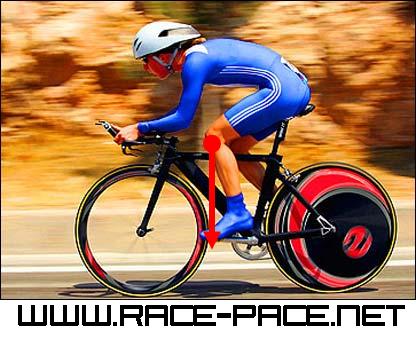
I recently published a post about how to get your saddle height right on your road bike in order to optimise your pedal stroke.  Another check you should consider making is whether your saddle is in the right fore and aft position relevant to your pedals.

To check this, you'll need a wall and a plumbline.  Put your pedals in the quarter to three position and using the knee that is furthest forward, drop a plumbline from the knobbly bit on the side of your knee down.  The plumbline should go exactly through the centre point of your pedal axle.

If it doesn't, simply loosen off your saddle and adjust backwards and forewards until it does.  It will only take you a couple of minutes to check, by making this adjustment you can ensure that your power is going right through the pedal.

When you've done this, it may change your cockpit position forward or back, if it feels different then you should take note of how far backwards or forwards you have adjusted the seat and then change your stem accordingly by either shortening or lengthening.

When bike fitting, by doing this measurement of height and fore/aft, it then determines the correct stem length.  If you want a lower position on the bike, go long, if you prefer a more upright position on the hoods - go shorter.

If you have a look at the picture above of Nicole Cooke, you'll see that straight line down.   As always, if you want to get really serious, consult a bike fitting professional.

Sunday, 15 April 2012

Correct Saddle Height for your Road Bike

Ideal Knee Angle for Optimal Seat Height
Getting your saddle height right is one of the first things you should consider when taking delivery of your first bike.  If you don't you, you may lose energy through an efficient downstroke or uncomfortableness or injury by being too high or too low.

It's a common mistake to put the saddle up too high.  You can spot someone that is too high as their hips rock from side to side when they are cycling, by being too high you are not optimising the strength in your legs to get maximum power.

There's lots of ways which people may recommend to get the correct saddle height like 88.3% of your inseam or just straightening your leg out and putting your heel on your pedal.  All have their ups and downs.

One of the most reliable ways to figure it out is to get the old protractor out to look at the angle of your leg from your knee.


I'd recommend using this quick on-line calculator to get your initial seat height as a starting point, it should be pretty close.  When you've got that done, position the protractor on the knobbly bit of your knee and see what angle your knee joint is at the bottom of the downstroke.  Normally, around 155 degrees is where it should be at for the optimum to stop your hips rocking.

Ready, Set, Go

It will feel very different at first if you have been running your saddle too high.  In fact, you'll feel very strange and you'll be tempted to put it back up again - don't.   You'll find very quickly that you'll adjust to the new position.  In the beginning, you'll start to feel your quads really come into play.


Your quads are the muscle set above your knee which are one of the most important muscle groups for cyclists.  By bringing your saddle down, you'll be using your quads a lot more to push the pedals and you'll develop more leg strength.  So, stick with it and it and you'll really begin to get some benefit as your muscle group develops. As usual, if you have any pre-existing medical conditions, consult a professional.

Friday, 5 November 2010

Choosing the correct crank length


An often overlooked consideration on road bikes is the length of your crank arms, relative to your leg length.

As a first time rider, you don't even realise there are differing lengths, nor their importance. It's just the thing that turns the chain round and you screw your pedals in to, isn't it?

Most shop bikes come with a 170mm or 175mm crank arm as standard, which if you're over six foot (which I am), 175mm is generally the right length due to your inside leg relative to your height. However, if your legs are a bit shorter, it may well suit you to have a shorter crank arm.

Here's why. When you're new to road cycling, most training manuals point you to a cadence (pedal rotations per minute) of around 85pm, in order to help you build aerobic capacity and reduce muscle fatigue (the Lance Armstrong method pretty much). If you have shorter legs and a long bike crank arm, it can mean your pedalling isn't as efficient as it could be as the overall rotation has to go through a bigger arc, relative to your leg, meaning you may not be getting the most from your muscles.

Now, on your first bike, this won't be a big issue as you're starting out, getting used to things, doing all the learning and things like crank length won't have any noticeable impact on your new hobby.

However, if you start to get addicted to cycling (as I did) and you hanker after your next bike, you want to get faster, look at the science a bit more and get more into things like geometry and fit, you should make sure you ask the question at your local bike shop. Selecting the right crank length for your new bike should be one of your considerations.

I had a body scan, which established the right frame size, optimum crank length etc, however there are plenty of articles on the web about it, like this one if you want to read up about it. I also found this article which offers a crank length formula if you really want to go to town.

Final thought is if you do change your crank arm length, you'll also need to adjust your seat height to compensate. If you're in the North West, come see me and I'll get you all fitted up on your bike.

Thursday, 9 September 2010

Meeting Graeme Obree (Part I)


Last night, I spent a good amount of time with former World Individual Pursuit Champion and Hour World Record Holder Graeme Obree. I hired Graeme as a speaker for an after dinner talk and – as a result – got to spend a lot of time with him one to one. It was fascinating to meet him and I had so many questions, we spoke for about an hour in the bar of the hotel as I scribbled notes furiously.

Since getting into cycling over a year ago, I’ve read many biographies and The Flying Scotsman (his biography) was one of those that I really enjoyed. I saw the film on TV a couple of months back which I highly recommend you watch.

Reading the book and watching the film quickly established that his life had been full of adversity, serious challenges and – at times – failure. His well documented battle with mental illness simply goes to underline the strength and resolve he subsequently showed in breaking Franceso Moser’s record in 1993. I wanted to focus our time together on his cycling achievements, rather than his battle with bi-polar disorder.

Speaking to him, what strikes you about Graeme is his intensity. He’s either staring you steely straight in the eyes or looking the other way when talking. He’s a maverick. Outspoken. Single-minded. Opinionated. Highly analytical. Focused. Quirky at times. He’s been compared to James Dyson in the way he analyses problems and finds solutions, using first principles for solution searching.

Underneath all of this was someone who is a genuine person with an amazing story and a large dose of modesty and – after the initial nerves – we warmed to each other and relaxed. On many questions, he really paused before answering, considering details, asking that some responses not be published, for political (cycle politics) reasons. I agreed to this, so some elements of the conversation have to remain with me.

I’ve captured as much as I can from our time together. For me, I wanted to get inside the head of a world champion. To understand what it was that made him tick? To understand how we kept going, in the depths of personal and sporting despair when the odds seemed stacked against him? Earlier in the day I’d asked on Twitter if anyone else had a question for him, these are answered below.

Question via @leeboyman – Rumour is that he has a book on training coming out. Is it true? A – True. Graeme is planning a book; however it is not yet started. It’s the next big thing he plans to work on and ideally would like it done for the Spring 2011. The book will cover road cycling, time trialling, training and nutrition.

Question via @leeboyman - Can you ask him if it's true that he just trains on 'feel' ie no heart rate monitor or power? A – True. Graeme told me that his set-up is as simple as this. He has a turbo-trainer at home, with a big screw in it so that the position never deviates or moves. He uses exactly the same track pump, inner tube, tyre and tyre pressure to ensure that his bike set up is absolutely constant over a long period with no deviation. Then he looks to constantly improve every time he trains - sometimes by only 0.5%. Therefore, he trains by feel only with no electronic measurement. Amazing.

Question via @adamleadbetter - I'd like to know what he thought of the film version of "Flying Scotsman"? A – He enjoyed the film, however has only watched it once and doesn’t like to watch it. He was careful to remind me that this was a film, not a documentary. There are some factual inaccuracies; however – in the main – it is representative of his life. He enjoyed the emotional and evocative style and felt that the film has introduced his story to a newer generation.

Q – Do you think you could ride in a team? Are you a team player? A – Yes I could but only if people were as obsessed about results as I am. If people can’t give critical feedback about their performance or mine, then it would serve no purpose for me to be there and I would be better to ride alone.

Q – Do you think the press attention dubbing Old Faithful “the washing machine bike” was detrimental to your career? A – Yes, sponsors didn’t take me seriously at the time, it meant that most of my career I’ve lacked serious sponsorship. Many people have offered me alternative sponsorships of types over the years, but I’ve refused it as I felt it would compromise by ability to speak out or do things my way.

Q – Do you think you would have liked to have ridden the Tour de France? A – Yes. He cites in the book that the amount of doping at the time meant that he could not have ridden the Tour and felt as if he was competing on equal grounds. He would have ridden it if this was not the case.

Tomorrow I'll put up the second post which contains information about his diet tips, advice for new road cyclists and all of the other general information I captured. To be continued...

Update. Here's the link to the second part of the interview and other Obree related articles I've posted.

Friday, 5 March 2010

Suits you Sir!


I went and had a full bike measure up today, you can read more about it here. Basically, it's a scanner combined with a piece of software, which - having done all the clever things it should do - suggests the most optimised set up for your bike based on your body shape.

Everything from seat tip to bar, seat to crank, seat height etc. I learned that I had pretty much got the set-up on my bike OK, however my key learning was that my seat was too far back, by about 3cm. As a result, my downward force was not as effective as it could be, now resolved!

Having done all the measuring of your vital statistics. it then means that you can select a bike which fits you more closely based upon the type of riding you do (Sportives/TT/Road). Of the couple of bikes I'm looking at, I was able to determine that both would fit OK and what sort of spacers I would need on the bars etc etc. It was worth the £50 investment as it's something you can use for all the bikes you ride.
Later in the morning, I stopped by frame manufacturer Terry Dolan's place. After exchanging a couple of e-mails with him, he said it would be OK to visit his office and look at one of the frames of the bike I'm considering, the Dolan Hercules SE. It was a pleasure to meet the man who has made frames for so many champions including Chris Boardman, Sir Chris Hoy and Bradley Wiggins. Unassuming, full of charisma and clearly a craftsman, he just took one look at me and pretty much confirmed the frame size, the spacers and seat height, just on sight. Now that's what you want!
Nipping back home, after taking the dog for a walk, I bumped into neighbour Gary just setting our on his way for a quick 20 miler. After a Superman quick change, I joined him for a nip round the block (so to speak). It turned out to be a bit of treck in the end, firstly, Gary's chain broke so he did a running repair. Secondly, the wind really picked up in the second half of the the ride, which made the back half harder than normal. We managed to get 21 miles done at about 15mph average.

Been an interesting day all in all. The bike choice is now narrowed down to the Dolan or the, Cannondale Synapse. I now know that they will both fit, it's just down to a question of preference I guess.